In 2026, a website is no longer just a digital brochure; it is a dynamic, AI-powered engine designed to capture leads and dominate search engines. If your site isn’t fast, smart, and optimized for the latest Google algorithms, you are losing revenue every second.
1. The Revolution of AI-Powered User Experience (UX)
Artificial Intelligence has changed how users interact with the web. In 2026, “Generic” is dead.
- Hyper-Personalization: AI analyzes user behavior to change headlines or images in real-time based on the visitor’s interests.
- Predictive Navigation: AI anticipates where a user will click next, pre-loading those sections to ensure zero lag.
- Visual Fidelity: Use high-resolution assets (optimized at 1600px or 1024px) that maintain quality while loading instantly through AI-based WebP or AVIF compression.
2. Dominating Technical SEO & Core Web Vitals
Google’s ranking factors are now strictly performance-based. To rank on page one, your technical foundation must be flawless.
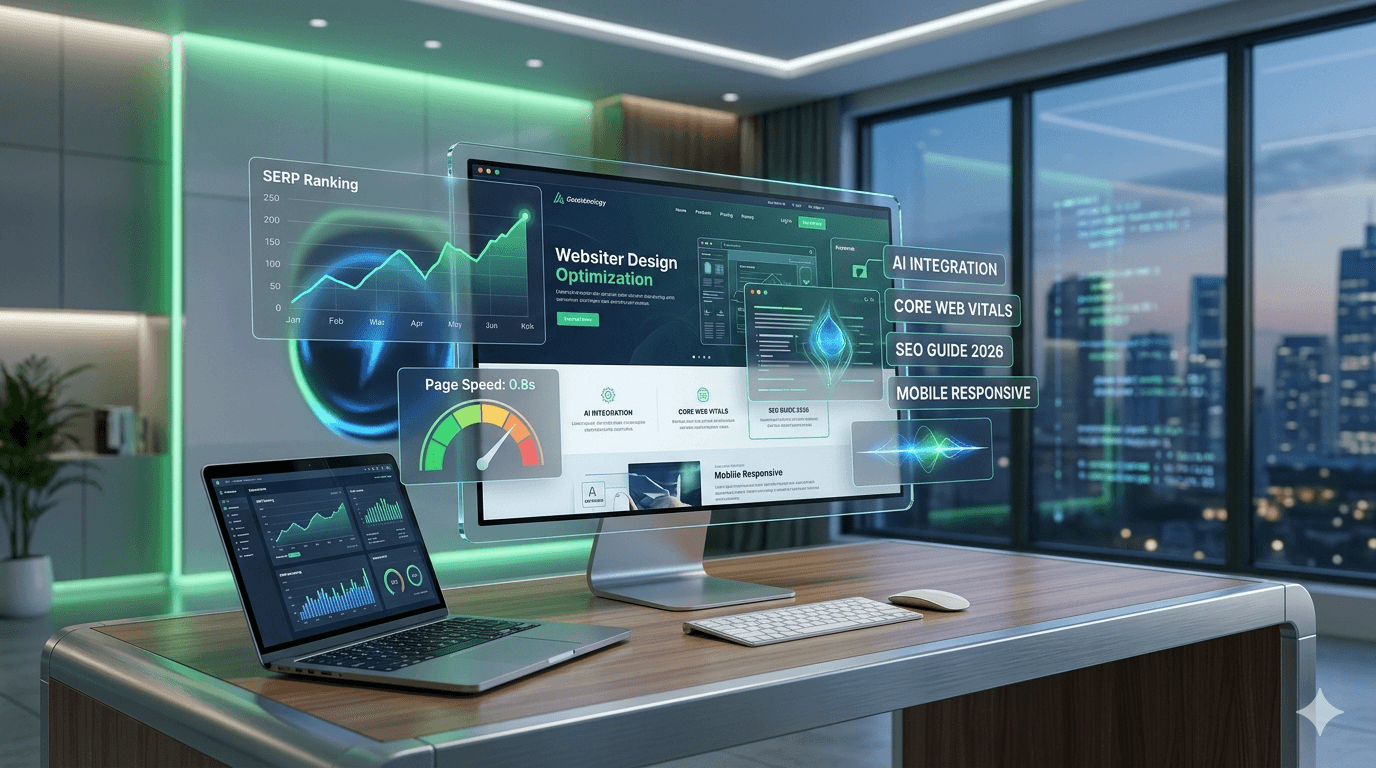
- Core Web Vitals: You must achieve a “Green” score in LCP (Loading), FID (Interactivity), and CLS (Visual Stability). A delay of even 0.5 seconds can drop your ranking.
- Crawl Budget Management: Use optimized XML sitemaps and clean
robots.txtfiles to ensure Googlebot spends time on your high-value service pages. - Semantic Search: Move beyond simple keywords. Use Keyword Clustering and LSI (Latent Semantic Indexing) to build “Topical Authority” in your niche.
3. High-Converting E-commerce & Business Layouts
Whether you are a local service provider in Delhi NCR or a global E-commerce brand, conversion is the ultimate goal.
- Frictionless Checkout: Reduce clicks from “Add to Cart” to “Payment.” Integrate seamless gateways like UPI, Apple Pay, and instant credit options.
- Psychology of Color: Use high-contrast Action Buttons (like a vibrant #0CC26A) to draw the eye toward “Contact Us” or “Buy Now” prompts.
- Mobile-First Indexing: Ensure your mobile UI is as powerful as your desktop version. Google ranks the mobile version of your site first.
4. Building E-E-A-T (Experience, Expertise, Authoritativeness, Trust)
Google’s algorithm favors content that proves human expertise in an AI-saturated world.
- Real Case Studies: Don’t just list services; show results. Detail how you solved a specific problem for a client.
- Secure Infrastructure: An “HTTPS” certificate is mandatory. Security is a direct ranking factor in 2026.
- Local SEO Mastery: Optimize for “Near Me” searches by embedding Google Maps and local business schemas to capture the Delhi NCR market.
5. Voice Search and Natural Language Processing (NLP)
With the rise of AI assistants, people are searching with full sentences rather than short phrases.
- Conversational Content: Structure your blog sections as answers to common questions.
- Long-Tail Keywords: Focus on phrases like “How much does a custom E-commerce website cost in 2026?” to capture high-intent traffic.
Q1: What is the most important factor in a website design in 2026?
A: In 2026, User Experience (UX) and Page Loading Speed are the top ranking factors. Google will prioritize websites that load in under 2 seconds and use AI to offer dynamic, personalized content to each visitor.
Q2: How much does a professional website design cost in 2026?
A: The cost can vary based on complexity. A basic business website can start from ₹25,000 to ₹50,000, while a complete Custom E-commerce website with advanced AI features may range from ₹1,00,000 to ₹3,00,000+. It is best to choose a package that offers both design and long-term SEO support.
Q3: Can an old website be optimized for SEO, or do I need a new one?
A: Yes, an old website can absolutely be optimized for SEO through a technical audit. This involves improving the site’s loading speed, fixing broken links, updating content to meet E-E-A-T standards, and making it fully mobile-responsive. You only need a complete redesign if the underlying technology is obsolete.
Q4: Do I need a custom design, or is a template enough for SEO?
A: While templates are good for quick setups, a Custom Design is always better for long-term SEO and branding. Custom sites are lighter, load faster, have clean code that is easy for Google to crawl, and are designed specifically to improve Conversion Rate Optimization (CRO).
Q5: What is the role of AI in modern website design?
A: AI helps create “Smart” websites. In 2026, AI is used to optimize images instantly for better speed, track user behavior to personalize their journey, integrate intelligent chatbots for customer service, and even predict future traffic trends using tools like SEMrush.