
Campaign pages built around one offer and one action — so the budget you’re spending on clicks has somewhere useful to land.
Above the fold on a 375px screen, before any scroll: what’s being offered, who it’s for, and how to act. That’s the constraint. Everything else is negotiable.

A homepage is built to serve everyone: existing customers, job applicants, suppliers, people checking you’re real. It offers twenty paths.
Someone clicking an ad for one specific service doesn’t want twenty paths. They want confirmation they’re in the right place and an obvious way to proceed. Send that person to a homepage and they have to find their way to what the ad promised — and a meaningful share won’t bother.
That’s the whole argument for a landing page. Same traffic, same budget, one offer instead of twenty.

The most common reason a campaign underperforms isn’t the page design. It’s that the ad and the page don’t say the same thing.
If the ad promises a free consultation, the headline says free consultation — not “Welcome to our company”. If the ad targets a specific service, the page is about that service, not your full range. If the ad names a price, the page confirms it rather than hiding it behind an enquiry form.
Every break in that chain costs conversions, and it costs them after you’ve already paid for the click.
We write the page against the actual ad copy, not against a general brief. If the campaign has several ad groups saying different things, that usually means several pages rather than one.
Welcome to our company
Illustrative example, not a client campaign.
What is the one thing a visitor should do? Pick one:
Only one. A page offering three equally-weighted actions converts worse than one offering a single clear action, because choice introduces hesitation at exactly the moment you need momentum. Secondary actions can exist — they’re just visually subordinate and positioned lower.
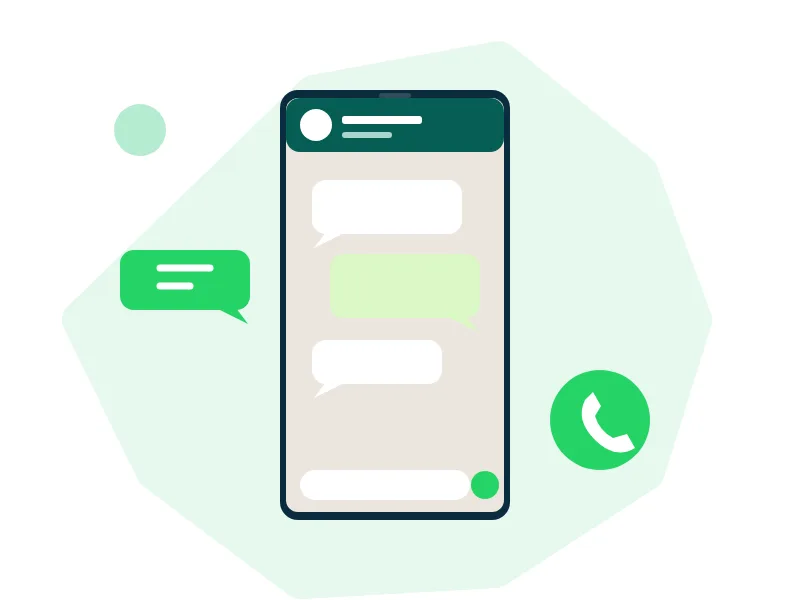
The visitor completes the pre-filled message — it starts as a question, not an application.
For most UAE campaigns, WhatsApp outperforms a form. A form asks for commitment before any value has been exchanged. A message feels like a question, not an application.
Forms still have a place — for higher-value B2B enquiries, or where you need structured information before responding. Where both are offered, we keep the form short. Every additional field costs completions, and most fields exist because someone thought they’d be useful rather than because they’re necessary.
Some sectors have advertising requirements that affect what a landing page can say and what it must display. Building this in from the start prevents a campaign being rejected or paused after launch.
Property advertising in Dubai requires a valid Trakheesi permit number issued through the Dubai Land Department, and the permit number must appear on the advert. Abu Dhabi operates a separate system, Madhmoun, through the Abu Dhabi Real Estate Centre. Off-plan listings carry additional disclosure requirements.
We design property campaign pages with a designated, visible place for permit and disclosure information rather than squeezing it in afterwards.
Obtaining and maintaining permits is your responsibility, not ours.
Medical advertising in Dubai falls under Dubai Health Authority standards, which restrict absolute and exaggerated claims — wording such as “the best”, “100%”, “no side effects”, “guaranteed” and “immediate results” is not permitted, and claims about treatment outcomes need to be evidence-based.
We write campaign copy within that framing from the outset, rather than producing headlines that your medical director then has to reject.
Final content sign-off rests with your licensed medical director.
If your campaign targets an Arabic-speaking audience, an Arabic landing page can be scoped rather than an English page with a translated headline. Done properly, the full page mirrors to right-to-left, including form fields and CTA placement, with a realistic timeline agreed upfront since this isn’t a page type we’ve built before.
Financial services, education and a few other sectors carry their own advertising requirements. If yours does, tell us at the briefing stage.
This is practical build guidance, not legal or regulatory advice. Verify current requirements with the relevant authority.
A slow landing page costs you twice over. Visitors leave before it renders — and you’ve already paid for that click. And page experience feeds into ad platform quality signals, which affects what you pay per click going forward.
Campaign traffic arrives on mobile data, often through an in-app browser. That’s the slowest realistic condition, so that’s what we test against.

Traffic sources are distinguishable.
Tells you whether the hero button, mid-page CTA or sticky button actually drives contact.
WhatsApp clicks, form starts, form submissions and call clicks.
Conversion tracking for Google Ads and Meta.
Checked before launch — events that were never tested are usually events that were never working.
One page rarely serves every campaign well. Separate pages make sense when:
Once a base page exists, variants are considerably cheaper than the first build.
A store campaign usually sends traffic to product or collection pages, which is where ecommerce website design in Dubai applies; a service campaign suits a standalone page shaped by the principles on website design in Dubai. Our wider service range is on the UAE page.
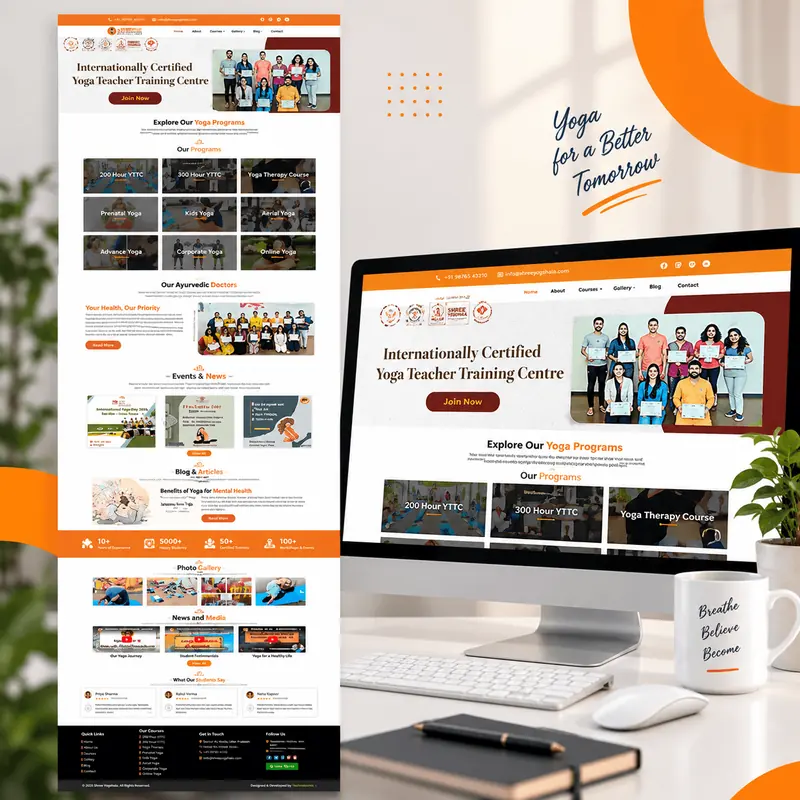
A single-purpose page built for one goal: enrolment into an internationally certified yoga teacher-training programme.
What changed: a visitor arriving to research one specific programme sees that programme, proof it’s credible, and one clear next step — the same structure this page recommends for a paid-campaign landing page, applied here to organic and referral traffic instead of ads.
The offer, the audience, the traffic source, and the one action that defines success.
Reading the actual ads so the page matches what was promised.
Message order and wording, built around the conversion.
Mobile first, because that’s where campaign traffic lands.
Lightweight and fast, with a performance target.
Conversion events configured and verified firing.
Live before the campaign starts, tested on real devices.
What the data shows once traffic arrives, and what to change.
Tell us what you’re promoting on WhatsApp — we reply within 10 minutes.
Less than a full website. The number depends on whether copy is written for you, how much custom design is involved, whether you need an Arabic version, and how many variants you want. Additional variants after the first cost significantly less, since the structure already exists. We quote per campaign rather than publishing a rate, because a single-offer page and a five-variant test are different pieces of work.
Faster than a full website — typically achievable well within the 15-day minimum that applies to a full site build, though the exact timeline depends on how quickly the offer, copy direction and any required imagery are confirmed.
Yes, for both. Traffic from search and traffic from social arrive with different intent — search visitors are actively looking, social visitors were interrupted — which affects how the page is structured. We’ll adjust accordingly.
Yes, and for most UAE campaigns it should be. We set up click-to-chat with a campaign-specific pre-filled message and track the clicks so conversions appear in your analytics rather than disappearing.
Not always, but often. If you’re advertising different services, offers or audiences, separate pages will outperform one general page. After the first build, additional variants cost considerably less.
No. Campaign pages are typically built for paid traffic rather than organic ranking, and are configured so they don’t compete with your main service pages for the same search terms.
Campaign management can be scoped alongside the landing page as a separate service — ask us when you’re ready to talk about it.
Through tracking configured before launch: conversion rate, which CTA is driving contact, and where visitors stop scrolling. Without that, any change you make afterwards is guesswork.
Yes, it can be scoped as a proper right-to-left layout rather than translated text inside an English design — headline, form fields, CTA placement and the WhatsApp button mirrored. This would be a first build of this kind for us, so we’d agree a realistic timeline and a proper testing pass as part of the quote, rather than treating it as a quick add-on.
Tell us what you’re advertising, where the traffic comes from, and what you want visitors to do. We’ll build the page around that.
Also see: Website design · Website development · WordPress · Ecommerce · Shopify · All UAE services